
Meeting MSC for the CTPAT Risk Assessment
Whether you’re new to CTPAT certification or are preparing for validation or recertification, the U.S. Customs and Border Protection’s (CBP) minimum...
2 min read

See transcription of the video below in case you want to read and not watch!
If you are a member of the CTPAT program, you are probably familiar with the term “Five Step Risk Assessment.” A supply chain risk assessment for CTPAT is a very important part of staying compliant and keeping your supply chain protected.
A well-documented 5-step risk assessment helps you reduce errors in supply chain security risk assessments and keeps you prepared for future validations and audits. Below, the steps of a CTPAT 5-step risk assessment process are laid out for you.
The first step in the 5-step risk assessment process is to evaluate both your internal controls and your external business partners.
Internally, this will include facility reviews and management meetings. This also includes security evaluations that go over your procedures and physical security, as well as examining your employee routines and cybersecurity.
Externally, it’s typical to evaluate vendors, suppliers, and other partners with security questionnaires and onsite audits. Many organizations choose to use a supply chain security risk assessment tool like Veroot provides to make this process simpler and easier to keep documentation in line.
The next step is understanding the risks and procedures associated with your geographical service area.
Companies should carry out a regional threat assessment as part of their CTPAT risk assessment process. This includes evaluating potential cargo theft, organized crime, cyber threats, and so on for the countries and regions you regularly work with.
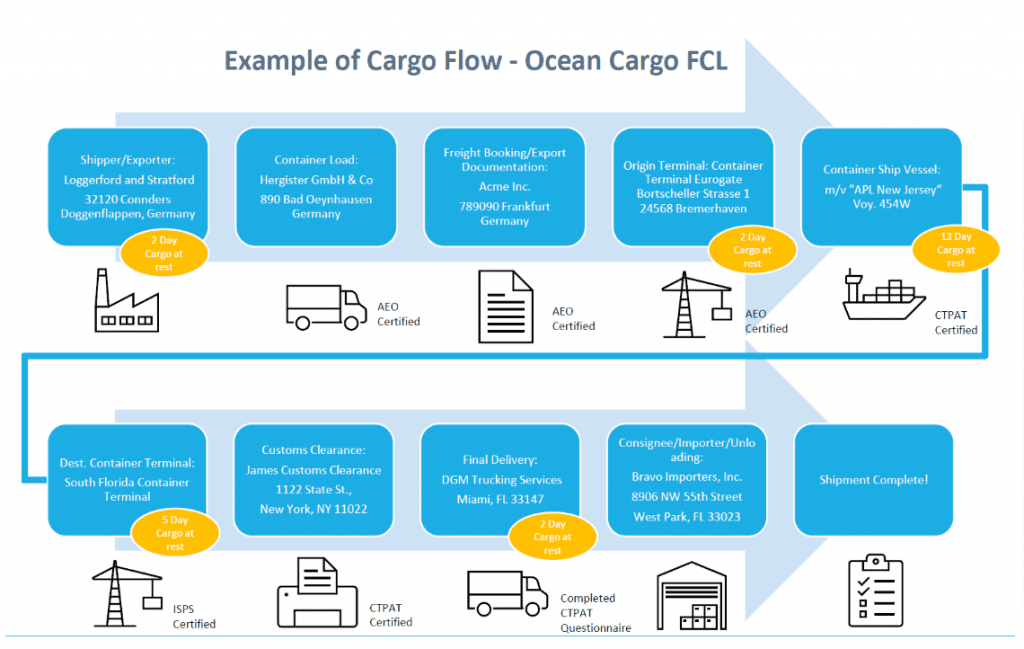
Cargo mapping is an excellent tool that organizations can use to visualize how shipments are moving through your supply chain. Cargo mapping for the 5-step risk assessment process keeps track of shipment flow from place to place. It also keeps track of handoff points and where security vulnerabilities may be likely to be present.
Cargo mapping is a great way to reveal opportunities to make process improvements and reduce errors in CTPAT procedures.
If a risk is identified during any earlier steps in your 5-step risk assessment or at any point during your supply chain processes, it’s important to take care of them quickly. The 5-step risk assessment prioritizes creating a corrective action plan.
Corrective action plans in your CTPAT risk assessment should cover:
The risk you found
People or parties responsible
The required correction and plan
When the issue should be resolved by
Any other supporting evidence
Without an action plan in your 5-step risk assessment, the purpose of your assessment isn’t really an improvement on your processes. It’s just documentation without needed action.
The final step in your CTPAT risk assessment process is to organize and document absolutely everything from step 1 all the way to the end. This includes management review meetings, logging steps of your action plan, gathering evidence for CBP questions, and much more.
Many companies are moving towards software to manage CTPAT risk assessments. These automated compliance systems are a great way to keep track of all your records in one place, make sure documentation is readily available to all who need it, and reduce errors in supply chain security risk assessments.
Veroot provides a CTPAT tracking software for risk assessments that can help your organization carry out a 5-step risk assessment with ease.
Veroot is here to help you improve your CTPAT risk assessment procedures with a software that guides you through every step of the process and makes sure you don’t miss a step in documentation. Schedule a demo today to learn more about our 5-step risk assessment software.

Whether you’re new to CTPAT certification or are preparing for validation or recertification, the U.S. Customs and Border Protection’s (CBP) minimum...

Discover the benefits of CTPAT membership, from reduced inspections to international recognition. Learn how Veroot can simplify the application...
CTPAT agricultural requirements can throw supply chain professionals for a loop. So what exactly are the rules, and how do you go about following...