

June 2026 Executive Order | Key Customs Enforcement Changes
On June 3, the federal government issued a new executive order for customs enforcement. Learn about the key changes that will increase accountability...
7 min read

The new customs enforcement executive order just made compliance a condition of entry. Here’s who it changes everything for.
June 3, 2026: The President signed the Strengthening Customs Enforcement executive order, transforming how the United States enforces customs law. It is long, it is technical, and it is easy to gloss over. Don’t. You need to know who is affected by the new customs enforcement order and how.
This order resets the price of admission for bringing goods into the country. It raises the bar on who is an importer of record, what they have to disclose, how much they have to bond, and what happens when they slip. “Good standing” with Customs and Border Protection becomes, for the first time, a gate you have to go through before you import anything at all.
In short, the customs enforcement order shifts CBP from punishing violations after the fact to gating who can import in the first place. It ups bonding and asset requirements, expands disclosures, links market access to “good standing,” and sends foreign importers through CTPAT. Most provisions will go into effect in 90 to 180 days.
You are who is affected by the customs executive order if you handle entries, owe duties, vet partners, or sign off on compliance. Below is who’s in the blast radius and what each group should start doing now.
Five groups are in the blast radius. Here’s the one-line stakes for each.
Old model: import first, get audited later, and pay penalties if you get caught. The new order flips that. CBP now wants proof of who you are, where your assets sit, and how clean your record is before goods cross the border.
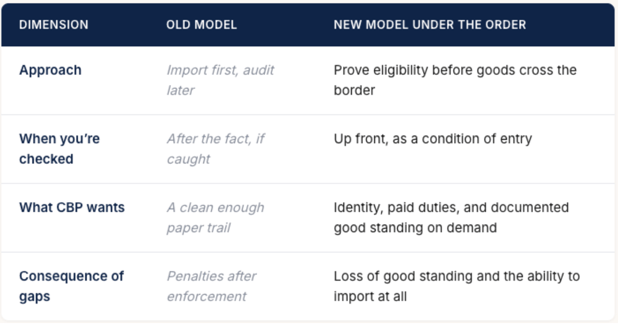
Every change in the order is motivated by three things.
There’s the legal side, the new obligations that CBP will put into regulation.
There’s the operational layer, the daily work of gathering disclosures, tracking bonds, and proving standing.
And there’s the trust layer, because the importers who can prove compliance quickly will continue to move freight while everyone else is waiting.
The clocks are already ticking. Most provisions are either 90 or 180 days. Legislation recommendations due in 45 days. The timetable isn’t forgiving, so let’s get specific about who’s affected by the customs enforcement executive order.
If you are a U.S. importer, the order treats you as the preferred party. That doesn’t mean you’re free from responsibility. There will be new requirements that were not there before.
CBP will also require all IORs to have a minimum level of tangible domestic assets, bonding, or both. Minimum bond coverage increases. Additional information at registration is required: expected import volumes, business establishment year, ownership and beneficial ownership, business affiliations, and domestic assets. CBP updates the IOR registry within 180 days, removing inactive accounts and placing active importers into risk-based tiers based on compliance history, enforcement actions, and audit results.
Then there’s “good standing.” CBP will determine it based on your record and your affiliates’ records, including duty payment history. Importers involved with fentanyl, nitazenes, precursor chemicals, or other illicit goods forfeit their standing. You lose that status and you can’t import. You can’t even designate a broker to act as IOR for you.
What this change means for you: your importer of record compliance posture is now your license to operate. Records stored in spreadsheets, email, and SharePoint won’t make the tiering review. You need one defensible system that shows clean duty payments, current disclosures, and a documented standing that you can prove on demand.
For foreign IORs, the customs enforcement executive order has the most impact. CBP is closing the gaps it says allow overseas actors to evade enforcement.
Foreign IORs will not be able to file an informal entry for low-value goods. This is a direct shot at the high-volume, low-value import flows that have clogged the system. Formal entry gets stricter too. Generally, you cannot rely on a continuous bond unless CBP is satisfied that the revenue is fully protected. If CBP finds you eligible, you will have to be validated in CTPAT or go through a CTPAT-validated, licensed customs broker.
The order draws a bright line between U.S. and foreign IORs. The U.S. IOR must be a U.S. citizen or permanent resident or an entity organized and located in the United States that has U.S. beneficial owners or significant U.S. real property. “Located in the United States” now means a real principal place of business, a real physical presence, and real tangible assets. Shell companies and fake structuring will not add up. CBP is working on specific guidance to prevent that workaround.
What it means to you: CTPAT compliance and domestic footprint are now key for market access. If you are importing to the U.S. from abroad, start the CTPAT conversation now because validation takes time you may not have. Get ahead of the executive order changes for foreign IORs.
The new customs executive order affects brokers. Brokers, you stand out, and the order increases your exposure. CBP will impose maximum penalties on brokers who do not exercise due diligence, repeatedly represent noncompliant clients, or do not respond to information requests in a timely fashion.
You are also engaged in enhanced repeated vetting with IORs, freight forwarders, and bonded custodians. And if a foreign IOR can’t validate in CTPAT directly, the order sends its formal entries through a CTPAT-validated broker. That’s you, with the risk on your license for the client.
What this situation means for you: client due diligence is no longer a courtesy; it’s a liability shield. You need a repeatable process to check each client’s status, record their disclosures, and document that you checked. “We didn’t know” won’t be accepted when the penalty floor goes up. It’s important to understand how the executive order changes things for brokers.
The June 3 customs executive order definitely affects bonded custodians and freight forwarders. You are in the same enhanced vetting net. CBP will conduct recurrent vetting of all individuals involved in activities related to importation, such as forwarders and custodians of bonded merchandise. The order also limits in-bond use and raises bond requirements for high-risk shipments.
What it means for you: brace for more scrutiny of the goods you move and hold and more demands for documentation around in-bond movements. The forwarders who can generate clean records quickly will keep their cargo moving, while the rest will be flagged for review.
If you are in compliance, the customs enforcement executive order will cover the next 12 months. The disclosure requirements are a project in themselves. CBP will require certifications of compliance with forced labor, CAATSA, sanctions, supply chain and production information, manufacturer product identifiers, and foreign tax and business identifiers. Importers will have to submit the documentation that the foreign exporter filed with its customs authority before shipping within 90 days.
The penalty math is also changing. CBP will establish a minimum penalty floor of at least 50 percent of the assessed amount, establish a liquidated damages floor, and eliminate mitigation for repeat offenders. Seizures are faster. Noncompliant goods can be disposed of by third parties. Voluntary abandonment is easier.
What this means for financial and compliance departments: manual evidence collection will lag. You are being asked to certify more, disclose more, and prove more, with shorter deadlines and bigger penalties for missing things. The annual audit rush must become real-time, continuous monitoring. That’s the only way to keep yourself in good standing without adding a headcount you don’t have.
Before the clocks go down, this is what to do. You don’t have to guess every regulation CBP writes. You have to be prepared to prove three things at any time: who you are, that your duties are paid, and that your standing is clean. That is the secret to robust compliance as an importer of record under the new customs enforcement executive order.
Start with mapping your exposure. See whether you, your affiliates, and your trading partners are U.S. or foreign IORs under the new definitions. Consolidate your beneficial ownership, domestic asset and affiliation data. It’s time to pressure-test your CTPAT status. It’s now central to formal entry for foreign IORs and a strong signal for everyone else. Then build the evidence trail that will survive a tiering review, rather than trying to reconstruct it under deadline.
This is precisely what Veroot was built for. We combine compliance software with practical subject matter experts who live in TSA and CTPAT requirements every day. Not only software. Not just guidance. A defensible system of record to keep you audit-ready as these rules take shape.
The order gives CBP months to do so. It gives you the same window to get out ahead of it.
Talk to a Veroot compliance specialist and prepare a readiness plan before the first deadline.
.png?width=1200&height=628&name=veroot-eo-guide-cta%20(1).png)
What is the executive order for customs enforcement?
It is called “Strengthening Customs Enforcement” and was signed on June 3, 2026. The order reforms the enforcement of customs law by U.S. Customs and Border Protection. It switches CBP from after-the-fact penalties to upfront eligibility, raises bonding and tangible asset requirements for importers of record, increases disclosure obligations, and makes “good standing” with CBP a prerequisite to import at all.
Who is affected by the executive order for customs enforcement?
U.S. importers of record, foreign importers of record, customs brokers, freight forwarders, and bonded custodians, along with their compliance and finance teams. Foreign IORs will experience the most significant changes, including loss of informal entry and the need to validate in CTPAT or file through a CTPAT-validated broker.
What should importers do to prepare for the customs enforcement executive order?
Be ready to prove three things on demand: who you are, that your duties are paid, and that your standing is clean. Map your exposure to see whether you and your trading partners are U.S. or foreign IORs under the new definitions, consolidate your beneficial ownership and domestic asset data, pressure-test your CTPAT status, and build an evidence trail that survives a tiering review instead of reconstructing it under deadline.
When does the executive order on customs enforcement go into effect?
The clocks are already ticking. Most provisions take effect within 90 or 180 days of signing on June 3, 2026. Legislative recommendations are due in 45 days. CBP will update the IOR registry, purge inactive accounts, and sort active importers into risk-based tiers within 180 days.

On June 3, the federal government issued a new executive order for customs enforcement. Learn about the key changes that will increase accountability...
Discover the differences between CTPAT Security and CTPAT Trade Compliance to determine which program best suits your company's needs.
CBP publishes fewer exams, front-of-line treatment, and FAST lane access as CTPAT benefits. Here's how to calculate what that's actually worth to you.