A signed security questionnaire is a promise. It is not proof. And CBP doesn't accept promises.
That's the gap most CTPAT programs miss. Collecting attestations from your overseas factories feels like vendor management. It isn't. CTPAT vendor management is the work that happens after the form comes back: confirming the factory actually operates the way it claims, closing the gaps you find, and checking again before the answer goes stale. Here's how to do that without drowning in it.
What is CTPAT vendor management? It's the process of vetting and monitoring the business partners that handle your cargo, and proving you did it. For overseas factories that aren't CTPAT-certified, and most aren't, CTPAT foreign manufacturer verification falls on you as the certified importer. You risk-tier each factory, verify it against the Minimum Security Criteria, close any gaps you find, and reverify on a schedule before the evidence goes stale.
What CBP means by "verify"
The Minimum Security Criteria don't stop at collecting security documents. They expect you to run written, verifiable processes for selecting and monitoring the factories that handle your cargo, and to keep verifying on a risk basis. Collecting documents is part of that work. During Foreign Validations, factories have to provide their SOPs and EOI to you as the Certified Importer and present them to CBP. Other entities provide shipping packets with inspection checklists, seal logs, and photos from the factory at the point of origin. And lately, even new applications are being asked to provide SOPs and EOI from overseas business partners. For any factory that isn't CTPAT-certified, and most overseas manufacturers aren't, that verification falls on you.
Read that last part closely. Risk basis. CBP isn't asking you to audit every factory to the same depth. It's asking you to know which factories carry the most risk and to verify those hardest. A program that treats a high-volume factory in a high-risk region the same as a low-volume domestic one isn't risk-based. It's just uniform, and an auditor will notice.
Step 1: Risk-tier your factories
You can't verify everyone to the same standard, so stop trying. Rank each factory by the things that actually drive risk: geography, commodity, shipment volume, certification status, and any history of findings or incidents. A certified factory shipping low-theft goods is a light touch. An uncertified factory in a high-risk corridor moving high-value cargo needs eyes on the floor.
This tiering is the backbone of the whole program. It decides how much verification each factory gets, and it's the documented judgment CBP wants to see behind your process.
Step 2: Verify against reality, not paper
The questionnaire tells you what the factory says. Verification confirms whether it's true. Match the method to the tier.
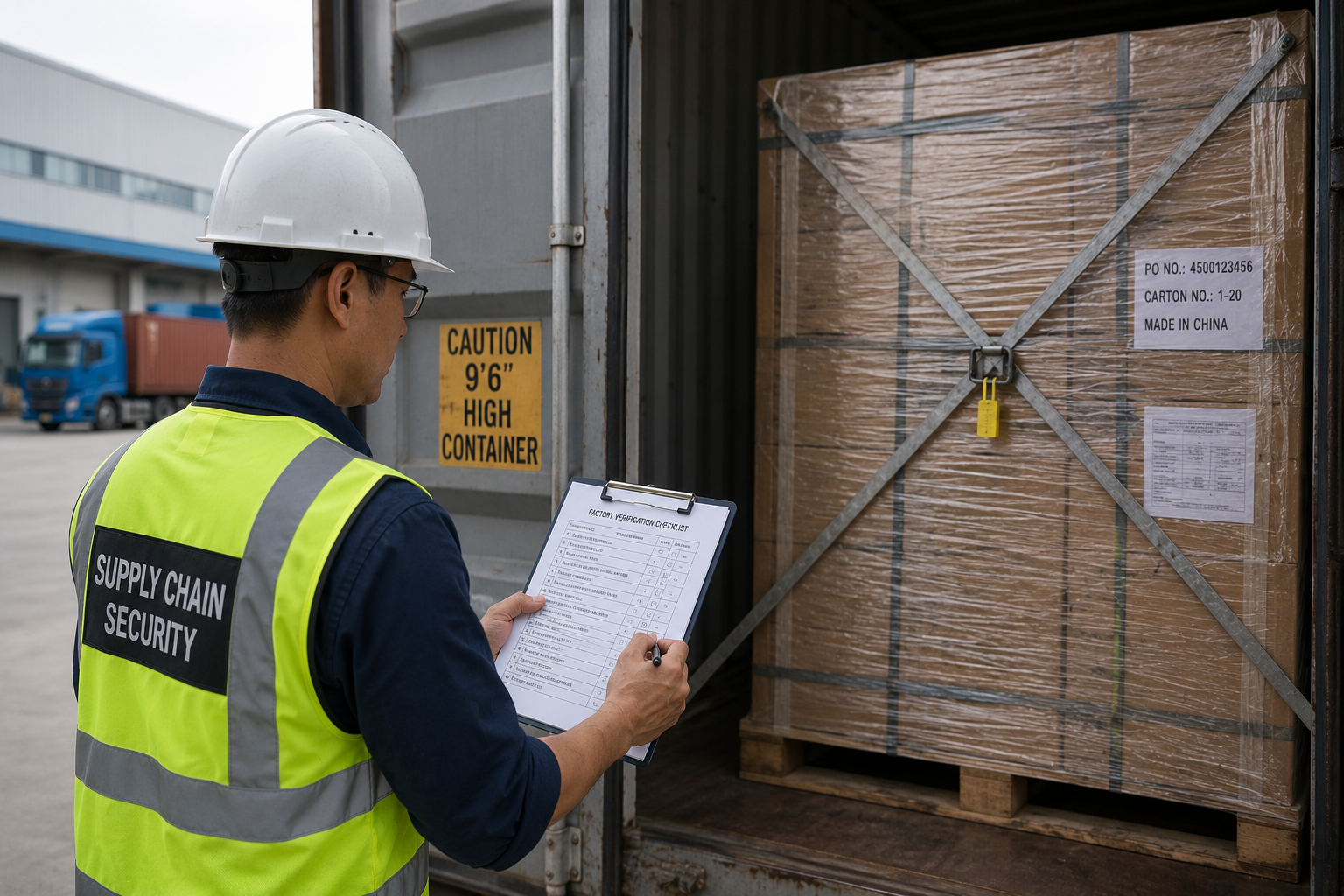
For lower-risk factories, a reviewed questionnaire plus current certification evidence may be enough. For higher-risk ones, you need more: a site visit, or an accepted third-party factory security audit, or dated photo and document evidence tied to specific criteria. What you're checking is consistent across the board. Perimeter and facility access controls. Point-of-stuffing and loading security. Seal controls using high-security seals to the ISO 17712 standard. Personnel screening. A documented container inspection process before loading.
The point isn't to collect more paper. It's to close the distance between what the factory attested and what's actually happening at the dock.
Step 3: Close gaps with corrective action
Verification that finds a gap and stops there is worse than no verification, because now you knew. When you find a gap, issue a corrective action plan: name the gap, name the owner, set a deadline, and confirm closure with evidence.
This is the part that flips a weakness into a strength. A gap you found, tracked, and closed is exactly what a mature program looks like in a revalidation. A gap sitting open in an inbox is a finding waiting to happen. CBP draws a hard line between the two.
Step 4: Reverify on a cadence
A factory that passed verification 14 months ago is an assumption, not a fact. Ownership changes. Facilities move. Certifications lapse. Build reverification into the program on a set cadence, annual at minimum and tighter for your high-risk tier, and require every factory to notify you when their status or location changes in between.
Continuous beats annual. The program that only checks at review time is running a yearly process against a year-round risk.
The CTPAT foreign manufacturer verification checklist
Run this on every factory, scaled to its risk tier. Keep the evidence dated and attributable.
CTPAT Foreign Manufacturer Verification Checklist
- Certification status confirmed (CTPAT, or AEO under a Mutual Recognition Arrangement) with a current certificate and reference number on file
- Risk tier assigned (geography, commodity, volume, history) and documented
- Security questionnaire reviewed against the factory's actual operations, not just filed
- Physical security verified: perimeter, lighting, access controls, alarms, and camera coverage
- Point-of-stuffing and loading area controls confirmed
- Seal procedures verified using ISO 17712 high-security seals, with seal control and reporting
- Container inspection process confirmed (structural and agricultural) before loading
- Personnel screening and background-check practices confirmed
- Verification method matched to risk tier (site visit, third-party audit, or documented remote review)
- Any gap logged with a corrective action plan: owner, deadline, and closure evidence
- Security point of contact named at the factory
- Reverification date set
Where CTPAT vendor management breaks
Every step above is manageable for one factory. The program breaks at scale. Run this across dozens or hundreds of factories in spreadsheets and folders, and within a quarter you can't answer the only questions that matter: which factories are verified, which are overdue, and where the open gaps sit.
This is the work Veroot's CTPAT platform is built to carry. You send and auto-grade business partner security questionnaires, track corrective action plans to closure, and run your management reviews from a single live roster instead of reconstructing them from email. Pair that with hands-on compliance experts, and verification becomes a system that runs on a cadence rather than a fire drill before every audit. Our customers hold a 100% Validation pass rate because their verification evidence is always current, not rebuilt under pressure.
Getting a factory to sign a questionnaire is easy. Proving it meets the standard, and proving you checked, is the actual job. Do that well and your overseas factories stop being the part of your program you hope nobody asks about.
See how your business partner program scores. Run a CTPAT maturity check in 5 minutes →
If factory verification lives in spreadsheets today, book a 30-minute consultation. We'll show you what verification at scale looks like when the system does the tracking for you.
Frequently asked questions about CTPAT vendor management
Does CTPAT require you to audit overseas factories?
Not a formal audit of every one. CBP expects a written, risk-based process for selecting and monitoring the factories that handle your cargo, with deeper verification for the higher-risk ones. You set the depth by risk, but you have to document the judgment behind it.
What is a CTPAT business partner security questionnaire?
It's the form you send a factory to attest how it meets the Minimum Security Criteria, covering physical security, seals, container inspection, personnel screening, and more. It's the starting point of verification, not the end. A signed questionnaire is a claim you still have to confirm.
How often do you have to reverify CTPAT factories?
Annual at minimum, and more often for high-risk factories. You should also require partners to notify you when their status, ownership, or location changes in between, so verification tracks real conditions instead of a once-a-year snapshot.
What seals does CTPAT require?
High-security seals meeting the ISO 17712 standard, plus a documented seal control and reporting process covering how seals are stored, applied, checked, and logged.