CTPAT (Customs Trade Partnership Against Terrorism) can often feel like its own language and has a way of sounding intimidating when digging in. Acronyms everywhere. Security jargon that sounds serious (because it is). And roles, processes, and security requirements that all somehow tie back to one thing: keeping the global supply chain secure.
But here’s the thing: CTPAT terminology isn’t just compliance vocabulary. These terms explain how supply chain security actually works, who’s responsible, what’s required, and how CBP evaluates whether security is truly embedded in daily operations. Whether you’re new to CTPAT or a seasoned participant who wants to stop nodding politely in meetings, understanding the core terminology is critical. Understanding the language helps teams communicate better, spot risks faster, and stay prepared.
Below, we’ve organized essential CTPAT terms into focused sections. Each group is organized by theme to show how each concept fits into the bigger picture, followed by clear, glossary style definitions explaining what each term means and how it fits into CTPAT.
The CTPAT Framework and Key Players
These terms form the foundation of the CTPAT program and define some of the main entities and individuals responsible for supply chain security.
CTPAT (Customs Trade Partnership Against Terrorism)
A voluntary partnership between the trade community and U.S. Customs and Border Protection focused on strengthening supply chain security. Companies that participate commit to implementing and maintaining security standards across their operations and supply chains.
CBP (U.S. Customs and Border Protection)
The U.S. government agency responsible for border security, trade enforcement, and oversight of the CTPAT program. CBP reviews security profiles, conducts validations, and determines a company’s CTPAT status.
Supply Chain Security Program
The policies, procedures, and controls a company uses to protect cargo, data, people, and facilities from security threats. This program is the operational backbone of CTPAT compliance and reflects how security is applied day to day.
Supply Chain Security Specialist (SCSS)
A CBP representative assigned to CTPAT members to review documentation, conduct validations, and provide guidance. The SCSS is the primary point of contact and plays a key role in evaluating whether a company’s security measures align with CTPAT expectations.
Minimum Security Criteria (MSC)
Baseline security requirements established by CBP for each type of CTPAT member. MSCs outline what CBP considers acceptable security controls across physical, procedural, personnel, and IT security areas.
Ownership, Accountability, and Documentation
CTPAT relies on clearly defined responsibility and well-documented security practices that can be demonstrated in real-world operations.
CTPAT Compliance Officer (Point of Contact)
The individual responsible for managing a company’s CTPAT participation, maintaining documentation, and coordinating with CBP. This role ensures security requirements are implemented consistently and maintained over time.
Security Profile
A detailed submission within the CTPAT portal that outlines a company’s security measures. It describes how the organization meets CTPAT requirements and is the primary resource reviewed by the Supply Chain Security Specialist (SCSS).
Business Partner
Any third party involved in a company’s supply chain, including manufacturers, carriers, brokers, and logistics providers. CTPAT members are expected to assess and monitor their partners’ security practices because security risks often exist outside a company’s direct control
Evidence of Implementation (EOI)
Documentation or records that demonstrate security procedures are actively in place rather than simply written in policy. EOIs may include photos, logs, training records, or inspection checklists that show how security is actually being applied and help bridge the gap between stated processes and actual execution.
Risk Management and Continuous Improvement
These terms reflect CTPAT’s risk-based approach and its emphasis on ongoing evaluation rather than one-time compliance.
Risk Assessment
A structured review of potential security vulnerabilities within the supply chain. Risk assessments help identify where threats may exist and guide decisions on where additional controls or monitoring may be needed.
Security Questionnaire
A tool used to evaluate the security practices of business partners. Questionnaires support due diligence efforts and help ensure that security expectations are communicated and understood throughout the supply chain.
Action Plan
A documented plan outlining corrective measures taken to address identified gaps or weaknesses. Action plans show CBP that issues are identified, tracked, and resolved rather than ignored.
Cyber, Financial, and Human Rights Risks
Modern supply chain security goes beyond physical assets and includes digital threats, financial crimes, and ethical sourcing concerns.
Social Engineering
Tactics used to manipulate individuals into revealing sensitive information or bypassing security controls. These attacks often rely on trust, urgency, or familiarity rather than technical vulnerabilities.
Phishing
Fraudulent messages designed to steal login credentials, financial information, or sensitive data. Phishing remains one of the most common entry points for cyber incidents within supply chains.
Trade-Based Money Laundering (TBML)
The use of legitimate trade transactions to conceal or move illicit funds. TBML can involve misdeclared goods, false invoicing, or complex routing designed to hide financial crime. Because TBML exploits normal trade activity, strong documentation, transparency, and partner oversight are critical for CTPAT members.
Forced Labor (Uyghur Forced Labor Prevention Act)
Forced labor occurs when individuals are compelled to work through coercion, threats, or lack of freedom. It presents serious human rights, legal, and compliance risks within global supply chains. The Uyghur Forced Labor Prevention Act specifically addresses forced labor concerns tied to the Xinjiang Uyghur Autonomous Region of China and places greater responsibility on importers. CTPAT members are expected to understand their sourcing practices and implement controls to prevent forced labor from entering their supply chains.
Cargo, Containers, and Physical Security Controls
These terms focus on securing the physical movement of goods—one of the most visible and critical aspects of CTPAT.
Instruments of International Traffic (IIT)
Reusable containers and equipment used to transport goods internationally, such as containers, ULDs, and trailers. IITs must be tracked, controlled, and properly secured or sealed to prevent unauthorized use, tampering, or diversion. Effective IIT controls help maintain cargo integrity and support overall supply chain security.
7/8 Point Container Inspections and 17/18 Point Trailer Inspections
Standard inspection processes used to examine shipping containers and trailers for signs of tampering, damage, or hidden compartments. CTPAT members are required to conduct these inspections prior to loading and sending cargo internationally using these instruments of international traffic.
High Security Seals
ISO 17712 compliant seals required for CTPAT members to secure containers and trailers during transit. Proper selection, application, tracking, and control of seals help ensure cargo integrity and reduce the risk of tampering or unauthorized access throughout the supply chain.
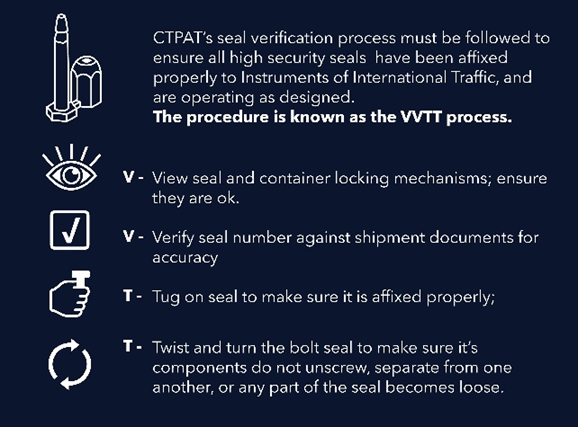
VVTT Seal Verification Process
A method used during inspections to confirm seal integrity through View, Verify, Twist, and Tug. This process helps ensure that seals are genuine, properly applied, and have not been compromised during transit. Please see the diagram below for VVTT instructions.
These terms and acronyms are not the only ones you may encounter throughout your CTPAT journey, but they are a strong foundation. Understanding this language makes it easier to navigate validations, communicate expectations internally and with partners, and recognize how different security requirements connect.
In the end, CTPAT is not about memorizing definitions. It is about understanding how people, processes, and controls work together to protect the supply chain. When teams share a common understanding of these terms, security becomes more practical, more effective, and easier to sustain over time. If you would like support on your CTPAT journey or come across new words or acronyms you just can’t quite make sense of, we are here to help.
 For more information or to request a demo, visit Veroot's website at www.veroot.com/ctpat



 Sarah Velazquez : Mar 16, 2026 4:24:53 PM