

3 min read

Most importers rely on their customs broker for nearly everything that touches U.S. Customs and Border Protection (CBP). So when CTPAT (Customs Trade Partnership Against Terrorism) comes up, it's reasonable to assume the broker has that covered too. In most cases, they don't. That isn't a knock on your broker. Below, we'll separate what your broker owns from what CTPAT asks of your company, and show how the two fit together.
The short answer: No. A customs broker's CTPAT certification covers the broker's own operation. It doesn't extend to your company, and it doesn't give your company CTPAT membership benefits. Your program belongs to the company that signed the agreement with CBP.
What Your Broker Is Responsible For
Who Owns What
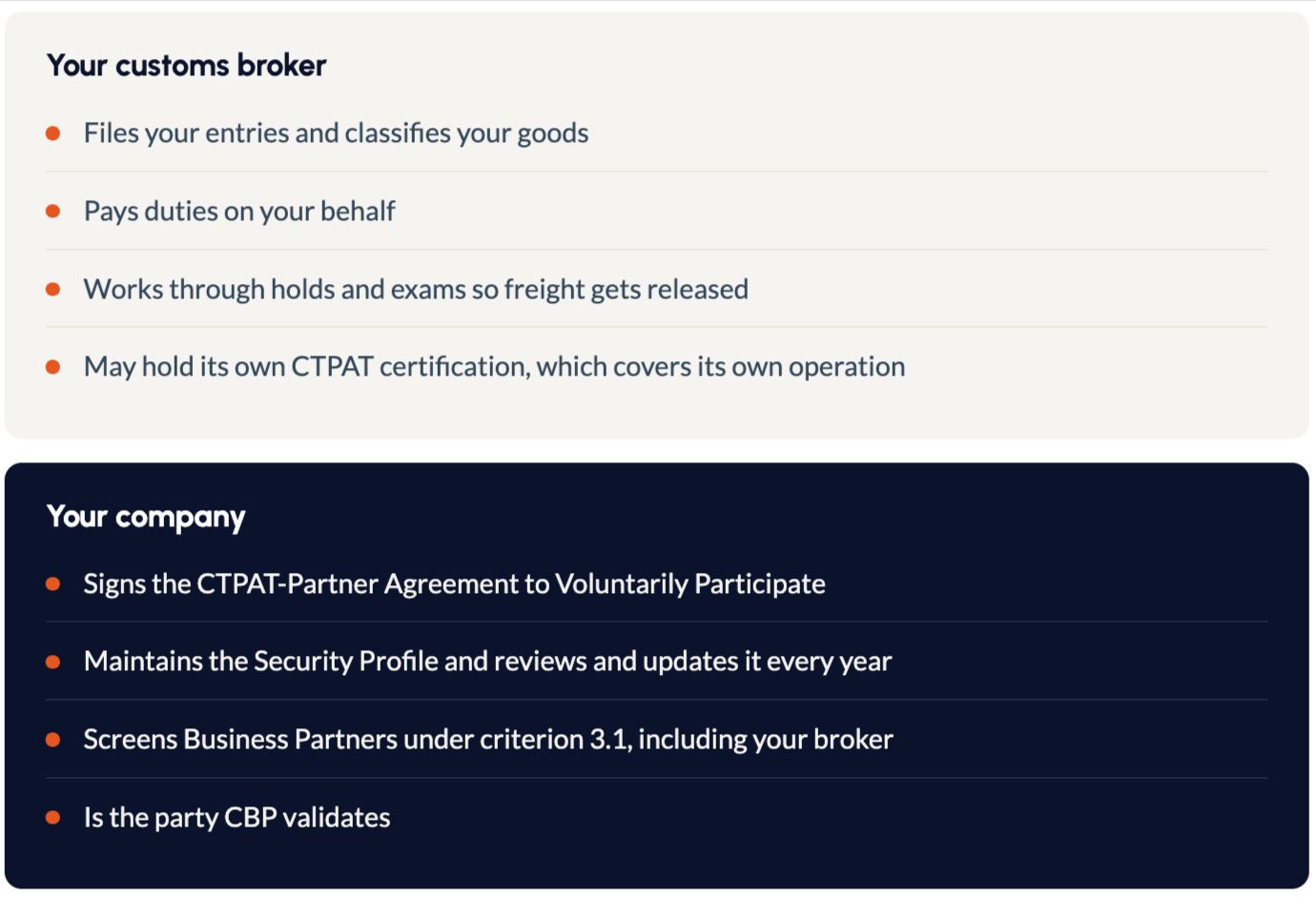
Your broker handles your customs business. They file your entries, classify your goods, pay duties on your behalf and work through holds and exams so your freight gets released. A good broker makes all of that easier, and nothing in this post suggests you need a different one.
Your broker may also be a CTPAT member. Customs brokers are one of the entity types CBP accepts into the program. That certification covers the broker's own operation. It doesn't make your company a member, and it doesn't satisfy any of your obligations as an importer.
A good next step is a simple one. Ask your broker whether they hold CTPAT certification, document the answer, and keep it with your Business Partner records.
What CTPAT Asks of Your Company
CTPAT is a voluntary partnership between your company and CBP. Your company signs the CTPAT-Partner Agreement to Voluntarily Participate. Your company maintains the Security Profile in the CTPAT Portal and has to review and update it every year. When a CBP Supply Chain Security Specialist (SCSS) validates your program, they look at your procedures and the evidence behind them, and that includes how you handle your Business Partners.
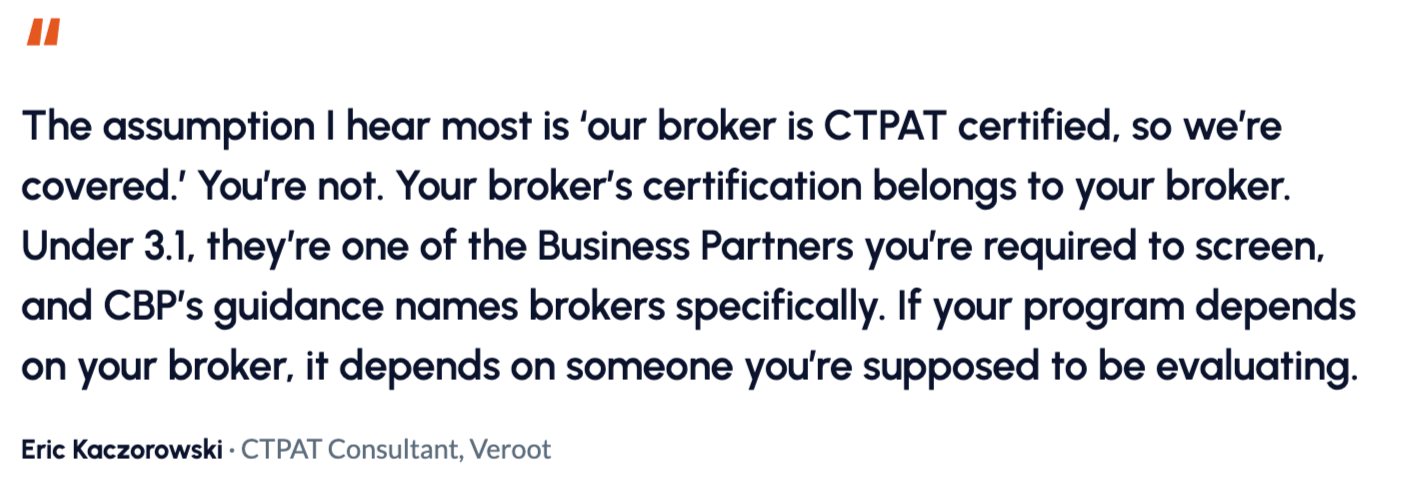
That last point is the one that surprises people. Criterion 3.1 of the Minimum Security Criteria (MSC) requires a written, risk-based process for screening new Business Partners and monitoring current ones. CBP's guidance for that criterion lists customs brokers among those partners. So your broker is a party your program evaluates, which is one more reason the program needs to live with you.
If nobody at your company has been named as the owner of the CTPAT program, that's the place to start. Pick one person and put it in writing.
Where Programs Tend to Slip
When a CTPAT program has no clear home, the same things tend to happen. Partner security questionnaires go out, half come back, and nobody has time to follow up. Seal logs stay at the warehouse. Training records stay with HR. The risk assessment lives in a file the last compliance manager wrote. And the annual Security Profile review lands during peak season and gets done the night before it's due.
None of this is carelessness. It's what happens when the work is spread across people who all have other jobs.
A practical next step is to put the evidence in one place, even a shared folder to start, and set a calendar for partner follow-ups and the annual review.
How a CTPAT Specialist Helps
A CTPAT specialist's whole job is keeping your program current and audit-ready all year. At Veroot, that work runs on software that acts as your system of record, so questionnaires and evidence sit in one place with a full audit trail. Hands-on CTPAT experts help you run it. The program keeps moving when your compliance lead is out, or moves on.
Veroot customers have submitted more than 250,000 partner questionnaires through the platform with a 100% acceptance rate.
Keep Your Broker, Own Your Program
The best setup is both. Your broker keeps freight moving. Your CTPAT specialist keeps the security program in order. Your broker relationship gets easier too, because requests for their documentation arrive on a schedule instead of in a rush before a validation.
There's a business upside as well. Larger customers increasingly ask for documented supply chain security during vendor onboarding and in requests for proposals (RFPs). When your evidence is organized, you can answer in an afternoon, and that keeps you on the shortlist.
If you're not sure where your program stands, reach out to us here at Veroot. Bring your current setup, spreadsheets and all, and we'll show you where the gaps are and what it takes to close them.
Frequently Asked Questions
Does my customs broker handle CTPAT for my company?
No. Your broker handles your customs business, like entries, classification and duties. CTPAT is a voluntary partnership between your company and CBP. Your company signs the CTPAT-Partner Agreement to Voluntarily Participate, maintains and annually reviews the Security Profile in the CTPAT Portal, and is the party CBP validates.
If my broker is CTPAT certified, does that cover my company?
No. A broker's CTPAT certification covers the broker's own operation. It doesn't extend to its importer clients or give them CTPAT membership benefits. Under MSC criterion 3.1, your broker is one of the Business Partners your program has to screen and monitor.
What does a CTPAT specialist do?
A CTPAT specialist keeps your program current and defensible year round. That means screening Business Partners on a schedule, collecting evidence as the work happens, and keeping the annual Security Profile review on track.