

4 min read

No. Executive Order 14411 does not require U.S. customs brokers to join CTPAT. But if you file formal entries for foreign importers of record, you'll need to be CTPAT-validated to keep that business once CBP's rules take effect. Certification alone may not count. Under Section 2(c), a foreign IOR that isn't validated in CTPAT itself has to use a CTPAT-validated, licensed customs broker. If that's not you, those clients will move to a broker who is.
CBP hasn't published the implementing rule yet. But validation can take up to a year after certification, so the brokers who wait for the rule will be late.
What does EO 14411 actually say about customs brokers?
Executive Order 14411, "Strengthening Customs Enforcement," was signed on June 3, 2026. You can read the full text on the White House site. Brokers show up in four places.
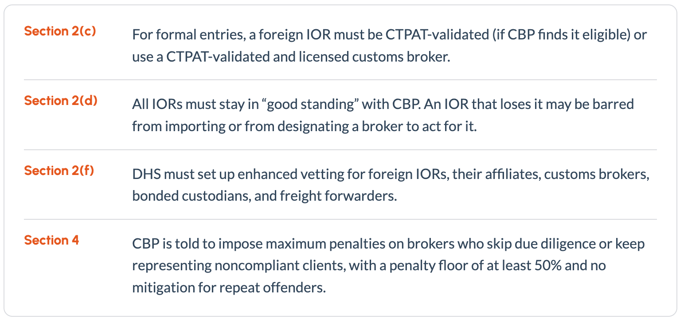
Notice what's missing. Nothing in the order makes CTPAT a condition of holding a broker license or filing entries for U.S. importers. Sections 2(f) and 4 apply to every broker, in CTPAT or not. Only Section 2(c) ties your CTPAT status to who you can file for.
Is CTPAT mandatory for customs brokers now?
No. CTPAT, the Customs Trade Partnership Against Terrorism, is still a voluntary program, and CBP's own application FAQ says so. You can keep your license, your filer code, and your U.S. importer clients without joining.
The pressure is commercial. CBP's August 2026 CTPAT alert for brokers says brokers who already hold validated status will become "the primary, and perhaps only, viable option" for foreign IORs. When the regulator describes your competitors that way, take it seriously.
Which brokers need to be CTPAT-validated?
It comes down to your client list.
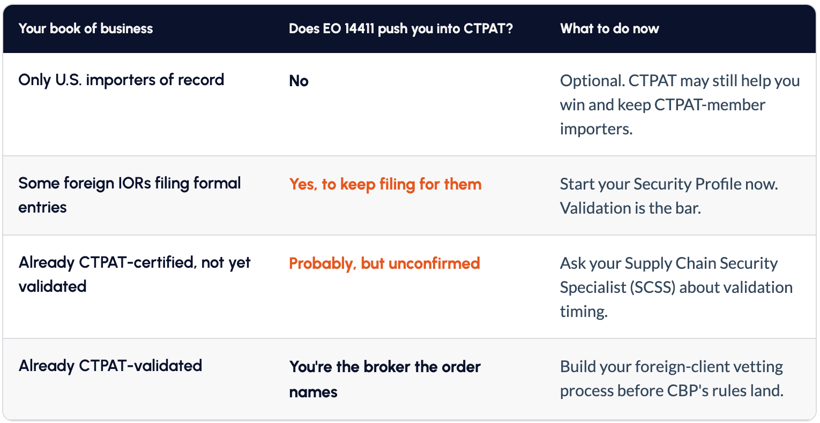
One caveat on "foreign." Section 10 defines a U.S. IOR narrowly: a U.S. citizen or permanent resident, or a U.S.-organized entity with its principal place of business, real operations, and enough tangible assets here, plus U.S. controlling owners. Some clients you think of as domestic, like a U.S. LLC run from overseas, may count as foreign IORs. Review your client list against that definition before you decide this doesn't apply to you.
What's the difference between CTPAT certified and CTPAT validated?
Certification comes first. You submit a Security Profile in the CTPAT Portal showing how you meet the Minimum Security Criteria for brokers, and CBP approves it. Validation comes later, when CBP's SCSS checks that what you described is actually in place, usually with a site visit.
The order and CBP's alert both say "validated." Whether a broker that is certified but not yet validated will count is still an open question. CBP hasn't answered it. Plan for validation and treat anything less as a gamble.
How long does it take a customs broker to get CTPAT-validated?
Longer than the rulemaking window. Under the SAFE Port Act, CBP has 90 days to certify an application and up to one year after certification to validate. Add the time it takes you to write a solid Security Profile, and a broker starting from zero is looking at several months to well over a year.
The order gave DHS 180 days from June 3, 2026 to revise importer eligibility, a window that runs to the end of November 2026. CBP's EO 14411 implementation page still describes the validated-broker duties as upcoming, and the rule could arrive later than the window. Either way, the start date is the variable you control.
To apply, CBP's broker eligibility requirements ask for an active U.S. customs broker license and filer code, a staffed U.S. office, a designated officer responsible for CTPAT, and a Security Profile that maps your policies to the broker Minimum Security Criteria.
What will CBP expect from a CTPAT-validated broker?
More work per foreign client. The August alert says validated brokers will need to vet foreign clients before doing any customs business. CBP expects you to verify:
- Legal identity, ownership structure, and business affiliations
- U.S. assets and import and compliance history
- Ability to pay duties, taxes, and fees
- Supply chain, classification, valuation, and country of origin details
You'll also need to keep records of that vetting, the power of attorney, and related communications to prove your due diligence. Brokers who fall short face financial penalties, more frequent audits, and possible suspension or removal from CTPAT.
That's the trade-off. Validation opens a market that unvalidated brokers can't serve, but it also puts your CTPAT status on the line with every foreign client you accept. Your onboarding process becomes part of your security program.
What should you do this quarter?
Start by sorting your clients against the Section 10 definition. Count how many formal entries you file for foreign IORs and what that revenue is worth. That number tells you how urgent CTPAT is for your brokerage.
If the number matters, start the Security Profile now. Write your foreign-client vetting procedure at the same time, using CBP's list above, so it's ready when your SCSS asks. And if you're already in CTPAT, keep your annual client outreach current. Veroot's guide to CTPAT client outreach for customs brokers covers what CBP looks for.
Where Veroot fits
Veroot pairs CTPAT software with specialists who help you build the Security Profile, document your procedures, and prepare for validation, then keep the evidence current so you're ready for the next review. If foreign IOR work is part of your brokerage, the vetting records CBP expects belong in the same system.
Talk to a Veroot CTPAT specialist about getting validated
Not sure you qualify yet? Run the 3-minute CTPAT eligibility check.

Customs broker CTPAT FAQ
Does EO 14411 require customs brokers to be CTPAT certified? No. The order doesn't make CTPAT a licensing requirement. It requires foreign importers of record to be CTPAT-validated or to file formal entries through a CTPAT-validated licensed broker, so brokers who serve foreign IORs will need validation to keep that work.
Is a CTPAT-certified broker the same as a CTPAT-validated broker? No. Certification follows CBP's approval of your Security Profile. Validation follows CBP's on-site review of your security measures. The order refers to validated brokers, and CBP hasn't said whether certified-only brokers will qualify.
How long does CTPAT validation take for a customs broker? By statute, CBP has 90 days to certify an application and up to one year after certification to complete validation. Your own preparation time comes on top of that.
Do the EO 14411 broker penalties apply only to CTPAT members? No. Section 4 directs maximum penalties for any broker who fails to conduct due diligence or repeatedly represents noncompliant clients. CTPAT members can also lose their CTPAT status.
Does it cost anything to join CTPAT? CBP doesn't charge a fee to join CTPAT. The cost is the internal time, and any outside help, to build and maintain a program that meets the broker Minimum Security Criteria.