

How to Prepare for a CTPAT Audit: What Audit-Ready Actually Looks Like (The Day-Of Test)
Learn how to prepare for a CTPAT audit by seeing what a real validation day looks like, the questions that catch unprepared programs, and how to test...
5 min read

Your last CTPAT revalidation packet probably worked. The next one might not. The written MSCs haven't changed for most operators. Importers and Foreign Manufacturers were updated in 2024, but the rest still trace back to 2020. What changed is how SCSS enforces them. The bar moved without a new rulebook, and most operators are still preparing for the evaluation that worked four years ago.
CTPAT revalidation is the periodic re-evaluation U.S. Customs and Border Protection (CBP) runs on every certified Trusted Trader to confirm the program still meets the Minimum Security Criteria (MSC). For most members it happens every four years, conducted by a Supply Chain Security Specialist (SCSS). The MSC document hasn't moved much. The way SCSS evaluates against it has.
I've sat through enough revalidations to see the pattern. The operator pulls the same packet they pulled last cycle. The auditor asks a question that isn't in it. The team scrambles. They get through, but barely, and they don't understand why the bar moved.
The bar moved because the enforcement moved. The MSC was updated for some entities, reinterpreted for the rest, and CBP got more specific about what counts as proof. Here's what's actually different now.
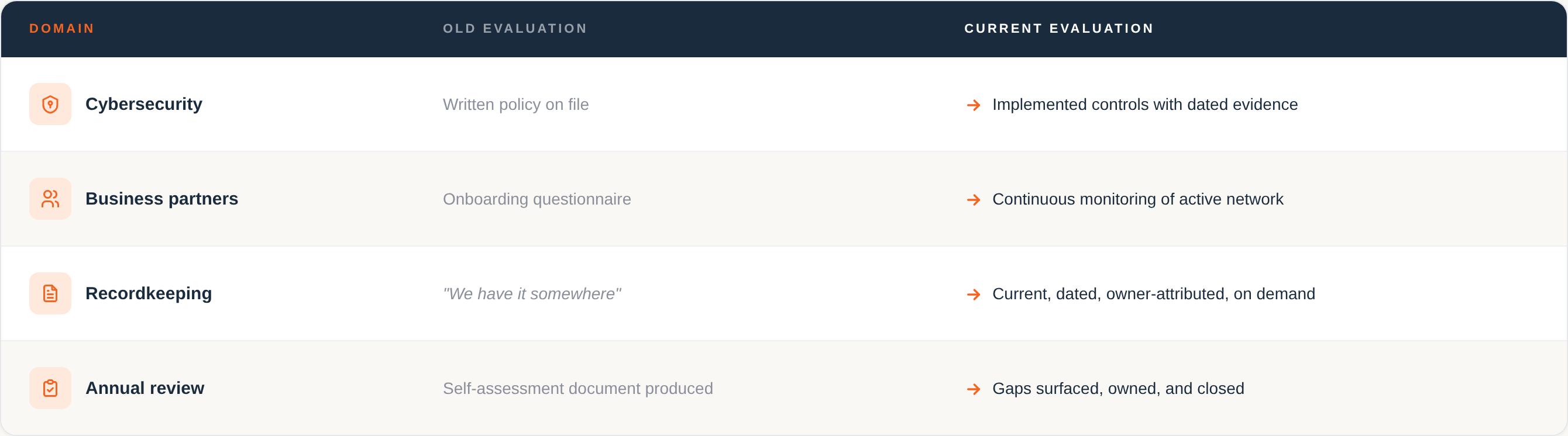
The old evaluation was whether you had a written cybersecurity policy. The current evaluation examines whether the policy implements, monitors, and supports the controls with evidence.
CBP wants to see access control posture, patch management cadence, and an incident response plan. They would like proof that you have actually run an incident response exercise. They want multi-factor authentication enforced, not just listed as a control. They want your last penetration test result, not a reference to "annual security testing."
A written policy with no evidence behind it now reads as a gap, not a control.
The old evaluation was whether you collected a security questionnaire when you onboarded a partner. The current evaluation is whether you know the security posture of every partner in your active network.
CBP is asking for the current roster, the current status, the date of last audit, and the monitoring cadence. They're asking what you do when a partner's certification lapses or their status changes. They're asking how you'd know.
If your business partner program is a folder of PDFs from intake interviews and an annual reminder to renew, you're exposed. The bar is now continuous, not periodic.
The old evaluation was whether you had records. The current evaluation is whether your records are current, complete, dated, and producible on demand.
CBP wants to see when an evidence item was last updated, who owns it, and what the source system is. They want the chain of custody that proves the evidence is real, not reconstructed for the visit.
This scenario is where SharePoint folder sprawl gets exposed. A folder full of documents with no date, no ownership, and no source system reads as an unreliable record. It's also where spreadsheets fail, because a spreadsheet has no audit trail.
The old evaluation was whether you produced an annual self-assessment document. The current evaluation is whether the review actually surfaced gaps and produced action.
CBP wants to see your last annual review. They also want to see what you did with it. Which gaps did you identify? Who owned the remediation? What's the status of each gap now? A mature program with no gaps reads as suspicious. A real program has gaps and closes them. A mature program shows the closure.
The trap is institutional memory. The last revalidation used a packet that worked. The team rebuilt the same packet for this cycle. The auditor was different. The questions were different. The gaps were exposed.
The solution isn't a bigger packet. The solution is a system of record that produces a current, dated, owner-attributed view of every requirement on demand. The packet becomes an export of your live state, not a one-off assembly.
That changes the prep cycle from a four-week scramble to a same-day pull. It also changes the failure mode from "the packet didn't match the question" to "we know exactly where every requirement stands."
The shift toward deeper evidence isn't a one-time event. It's the new pattern. CBP is steadily moving certified members toward a continuous, evidence-based program, most of it through how SCSS asks the questions, not through new written rules. Each cycle adds more depth in one domain or another. Members who treat each cycle as the same exam they passed last time will continue to fall further behind. Members who treat the program as continuous infrastructure will receive easier audits, not harder ones.
Your customers are doing the same thing. Supplier scorecards from the largest importers in the country now reference CTPAT control areas directly. They want the same evidence, in the same form, on the same timeline. The work to satisfy CBP is the same work that satisfies them.
Start by mapping where you are against where the bar actually sits today. Veroot's CTPAT maturity matrix scores your program across seven domains: governance and leadership, risk management, business partner management, operational security, training and culture, and technology and automation.
Each domain runs through five levels, from basic awareness, to designated ownership, to documented programs, to tracked and audited performance, to continuous, integrated execution. The score tells you which domain carries the highest risk in your next revalidation, how deep the gap is, and the realistic path to closing it before SCSS gets there first.
CTPAT revalidation is the periodic re-evaluation that U.S. Customs and Border Protection (CBP) conducts to confirm a certified Trusted Trader still meets the program's Minimum Security Criteria (MSC). The review is performed by a Supply Chain Security Specialist (SCSS) and combines a documentation review with a site visit.
CBP revalidates most CTPAT members every four years. Tier III members and members in higher-risk categories may see more frequent reviews. Members are notified in advance and expected to produce current evidence at the time of the visit.
The MSC are the baseline security requirements every CTPAT member must meet, organized by entity type (Importer, Foreign Manufacturer, Highway Carrier, and others). They cover physical security, access controls, personnel security, education and training, business partner screening, conveyance security, agricultural security, and cybersecurity. The Importer and Foreign Manufacturer MSC were last updated in 2024. Most others trace back to 2021.
The supply chain security specialist looks at evidence that the controls in your program are actually implemented, monitored, and current. That includes dated records, access logs, training completions, partner monitoring activity, incident response exercises, penetration test results, and the outcomes of your last annual self-assessment. They want to see who owns each control and what happens when something lapses.
Programs that operate from a system of record can produce a revalidation packet on demand. Programs that rely on SharePoint folders and spreadsheets typically need four to six weeks of scramble to assemble evidence, chase down owners, and reconstruct dates. The gap between those two states is what determines whether revalidation is routine or exposing.
CBP can suspend or remove a member's certification. Suspension means the member loses the trade benefits associated with CTPAT (reduced exams, front-of-line privileges, FAST lane access) until corrective action is documented and accepted. Removal is a longer road back. Most members don't fail outright. They land in a corrective action plan and spend the next cycle catching up.

Learn how to prepare for a CTPAT audit by seeing what a real validation day looks like, the questions that catch unprepared programs, and how to test...

Veroot's CTPAT team was at CBP's 2026 Trade and Cargo Security Summit in Dallas. What CBP said on Evidence of Implementation, EO 14411 and 2027.

Learn how to get your entire organization up to speed with CTPAT and the regulations associated with the new MSC.